Citation
Cosmo Gordon, of Cluny, "Unto the Right Honourable the Lords of Council and Session, the Petition of Walter Colquhoun, and his Tutors," 3 Feb 1767
, Scottish Court of Session Digital Archive Project. Charlottesville: University of Virginia Law Library, 2015-2019.
Related Case Materials
Unto the Right Honourable the Lords of Council and Session, the Petition of John Duke of Argyll
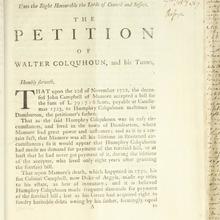
Unto the Right Honourable the Lords of Council and Session, the Petition of Walter Colquhoun, and his Tutors
Answers for Walter Colquhoun, and his tutors, to The Petition of John Duke of Argyle
Document text (uncorrected OCR)
F ebruary 3. 1767. ' Unto the Right Honourable the Lords of Council and Session. T H E P E T I T I O N O F l # W A L T E R COLQU HOUN, and his Tutors, * # I Humbly sheweth, T H A T upon the 22d of November 1722, the decea-sed John Campbell of Mamore accepted a bill for the sum of L. 79: 7: 6 Scots, payable at Candlemas 1723, to Humphry Colquhoun maltman in Dumbarton, the petitioner’s father. That as the said Humphry Colquhoun was in easy cir- cumstances, and lived in the town of Dumbarton, where Mamore had great power and influence; and as it is a cer tain fact, that Mamore was all his lifetime in slraitened cir- cumstances; so it would appear that Humphry Colquhoun had made no demand for payment of the foresaid bill, or at least that he had never got payment of it, during the lifetime of the accepter, who lived only eight years after granting the foresaid bill. That upon Mamore’s death, which happened in 1730, his son Colonel Campbell, now Duke of Argyle, made up titles to his estate, as heir of inventory; and it is believed Humphry Colquhoun made frequent demands for payment o f the foresaid bill; but as his Grace had acquired right to sundry heritable debts owing by his father, seemingly equal.,, A to to the subject of the inventory, that circumstance, joined to the situation of Humphry Colquhoun, who still resided in Dumbarton, and was post-m aster there, and was besides o- bliged to Colonel Campbell on several occasions, makes it easy for your Lordships to conceive, that the demands for payment of the foresaid bill would not be very pressing. That the bill in this manner lay over unpaid during the lifetime of Humphry Colquhoun himself: but, after his death, the tutors of his infant son having found the bill a- mong his other grounds of debt; and General Campbell ha ving succeeded much about the same time to the estate and dignity of Argyle; the petitioners, in duty to their pupil, demanded payment of the foresaid Bill from the Duke. That a demand to this purpose was made upon his Grace very soon after his succession to the estate; and upon that oc- casion he did by no means alledge that the bill was paid: on the contrary, from a conversation with the Duke of Argyle’s doer, the petitioners had reason to believe that the Duke did then acknowledge the justice of the debt, and was willing to pay it. The petitioners therefore delayed for almost two years to bring any action against the Duke; but as they could obtain no more explicit answer, and as the years o f prescription against this bill were nearly expired, so the peti tioners were laid under the necessity of calling his Grace in an action before this court, concluding for the principal sum of the foresaid bill, with interest from the term of pay ment. That the petitioners, still expecting that the Duke of Ar gyle would pay the bill, delayed insisting in the process for a considerable time; but seeing no appearance of any incli nation in his Grace to satisfy their demand, the action pro ceeded before Lord Auchinleck Ordinary; and his Grace ha ving first pleaded his privilege as a member of parliament, did afterwards propone two defences in caus a-, viz. 1 no, that being an heir of inventory, and having paid debts ex ceeding ceeding the subjects of the inventory, he could be no further liable. And, 2dly, His Grace pleaded the antiquity of the bill; that payment was thereby presumed, and any action upon it excluded on that account. That after various delays upon the part of the defender, he was at last pleased to produce his inventory, and the vouchers of the debts whereby he alledged the inventory was exhausted. Upon advising these, the Lord Ordinary, of this date, pronounced an interlocutor, decerning against the de fender in terms of the libel. And upon advising a repre- sentation against that judgment, with answers, his Lord- ship of this date pronounced the following interlocutor: "The Lord Ordinary having again considered this represen- tation, with the answers; repells the defence founded upon the antiquity of the bill, in respect it is not prescribed, and that there are no circumstances instru cted to presume that it was paid; on the contrary, the creditor is not de nied to have been in easy circumstances, and the debtor, according to his Grace the defender's own showing, by his other defence, appears to have been in a different situa- tion; which, with personal circumstances of the par ties, accounts well for the delay; and repells the other de fence, founded on the defender’s being served heir cum bene- f icio, in respect his Grace does not offer to assign the inven tory, which he has no title to hold, and to plead exhausted; and therefore finds the defender liable in payment; and de cerns.” That after this judgment was pronounced, the Duke of Argyle made proposals for an accommodation; which the pe titioners readily listened to; and a communing having ensued, his Grace made offer of the principal sum and annualrents: but the petitioners thinking themselves bound, in duty to their pupil, to insi st also for some part of the expence incurred in the process, and that otherwise the debt would in a manner be lost, they made a demand to that purpose. This the Duke of of Argyle positively refused. He declined paying any part of the expence, and stated the above-mentioned defences to your Lordships in a reclaiming petition. Tha t upon advising this petition, with answers for Walter Colquhoun and his tutors, your Lordships, of this date, pro nounced the following interlocutor. “ The Lords having ad- vised this petition, with the answers, find, That, post tan~ tum temporis, no action lies upon the bill in question; and therefore affoilzie, and decern.” The petitioners must be forgiven for restating this case to your Lordships; and as the judgment proceeds entirely upon the antiquity of the bill, without taking any notice of the Duke’s other defence, viz. the exhausted inventory, the peti tioners, without saying any thing on that point, shall con fine themselves entirely to the grounds of your Lordships judgment, and endeavour to show, that action still lies upon the bill in question; and if that point is established, the pe titioners take it for granted, that the other defence can be of no avail. And, upon this point, the petitioners, in the first place, do humbly beg leave to maintain, That no prescription hath run against this bill. It is very true, the years of prescription are nearly expired, owing partly to the petitioners having rea- son to believe, that the Duke of Argyle would pay the bill without any action; but still the prescription is not complete. The bill was payable at Candlemas 1723; and this action was brought in August 1762. Bills, by the law of Scotland, are probative writings. They have always been considered as legal vouchers and grounds of debt; and the lieges have accordingly, in their transactions, been in use to relie upon them as permanent securities for money. And when that is the case, the petitioners, with all submission, cannot discover upon what ground they can be limited in their duration to less than forty years. No prescription is known in the law of Scotland, except what what is introduced by positive statute. Bills are mentioned in none of the statutes establ ishing the shorter prescriptions. Sir George Mackenzie, in his observations upon the act 9th, parliament 1669, does observe, that the parliament expressly refused to bring bills of exchange under the vicennial prescrip- tion, “ because that were to limit them by too narrow sta- tutes.” And if they do not fall under any of the shorter prescriptions that from time to time have been established in the law of Scotland, it must necessarily follow, that no pre scription can take place against them, except the general pre scription of forty years. And the petitioners are advised, that these principles are received, and approved of by your Lordships practice. To demonstrate this, a recital of many cases is unnecessary. The petitioners shall content themselves with mentioning one de cided the same day that the interlocutor now complained o f was pronounced. The case occurred between John Maxwell writer in Dumfries and James Maxwell of Kirkconnel. John Maxwell, as executor of his brother William Maxwell o f Carsewadda, brought an action against Kirkconnel, for pay ment of a bill granted by the late Kirkconnel, whom he represented, to Carsewadda. Before bringing the action, both drawer and accepter were dead; and it was pleaded in defence, That the bill having lain so long over, no action upon it ought to be sustained. Your Lordships, however, repelled this defence, and found the bill actionable; al though almost thirty-one years had elapsed between the term of payment of the bill and the commencement of the action. The petitioners, therefore, must hold it as a principle, That bills endure for the full period of the long prescription. At the same time the petitioners will acknowledge, that in many cases your Lordships have refused to sustain action up on bills, even when the forty years were not fully elapsed. But in all Such cases, Something more must occur than bare- B ly l y the lapse of time; because, if your Lordships should refufe action upon a bill, merely on account of its antiquity, that is, in effect, to introduce a prescription not authorised b y law; and which therefore no court of ju stice whatever has a power to establish. In order, therefore, to found a defence against the pay ment of a bill which has not lain over forty years, it is ne- cessary, that, besides the lapse of time, some particular cir cumstances should occur; and the petitioners are advised, that such circumstances must occur as may give your Lordships reason to believe, that the bill has been paid, or some how extinguished. And, with great submission, the petitioners apprehend, that it is incumbent upon the party who pleads antiquity against a bill, to point out circumstances of that sort, if the prescription is not completely run; because, till that time, the bill is a subsi sting document, and the holder needs condescend upon no circumstances in support of it. I f it is in the hands of the creditor, unretired, the presumption is, that it is still unpaid, and unextinguished; and, conse- quently, must be actionable, unless that legal presumption is redargued by circumstances, inferring a stronger presump- tion to the contrary. To apply these principles to the present case, as the bill here was not prescribed, so, in order to support your Lord ships judgment, the petitioners, with great submission, ap prehend it is incumbent on the defender to point out some circumstances tending to infer a presumption, that the bill had been paid. I f your Lordships shall sustain lapse of time alone as sufficient, you introduce a prescription not introdu ced by law; and which, according to Sir George Mackenzie, the legislature purposely omitted. But the petitioners must be forgiven to say, that the Noble defender here cannot condescend on a single circumstance tending to create a belief, that this bill was ever paid or ex tinguished. Lapse of time alone is the defence here; and even even that, when the circumstances of the case are attended to, ought to he of no weight. For as Mamore lived only- eight years after accepting this b ill; ant'd as the defender does not alledge that ever he paid the contents of his father’s ac ceptance; so this bill ought to be considered as having lain o- ver only during the eight years that old Mamore survived the accepting of it. So short a space, unaided by any other circumstance, can afford no presumption of payment; especially in this case, where the situation of parties accounts so well for the ne gligence and delay on the part of the creditor. For, 1mo, From the defender’s own showing in this cause, it ap pears, that Mr Campbell of Mamore, the accepter of the bill, was in low circumstances when the debt was contracted, and appears to have continued in the same condition to his death. Humphry Colquhoun, the drawer of the bill, was always in good circumstances. In this situation, living in the town of Dumbarton, it is extremely probable he would not push Ma- more for so small a sum: And in that way the bill might very readily lie over for eight years, which was all the space Mamore lived after the contraction of the debt. Again, with respect to this defender, as he acknowledges, that the bill never was paid by him, so there were exceeding good reasons, why Humphry Colquhoun would not be very strenuous in demanding the payment. I n the first place, the defender was only an heir of inventory, and of course suppo- sed to take little by his father’s succession. It was said, indeed, That the defender, by serving cum benef icio, did in a manner intimate to his father’s creditors, to make their demands upon him. But as it appears from the defender’s own showing, that he had acquired right to his father’s heritable debts, ex ceeding the supposed value of the inventory, and as these debts were preferable to the bill in question; so, at that time of day, and between such parties, the preferable debts acqui red by the heir of inventory might easi ly have been used to B z elide elide any demand for payment of this b ill: At least, it is ex tremely probable, and reasonable to presume, that Humphry Colquhoun, the holder of the bill, might be thereby discoura- ged from demanding payment; at any rate, that it would prevent him from attempting to force the payment by legal diligence. And this is the father to be presumed, that the defender himself, till he succeeded to the honours and estate of Argyle though he held high offices under the government, was never- theless, by his rank and dignity, still exposed to an equiva lent, or rather a superior expence. In that situation, Humphry Colquhoun, who continued to reside in Dumbarton, and was post master there, might very readily neglect or decline to in sist for the payment of so small a sum: and the more so, that he had the honour to be always in good friendship with the defender, and, as the petitioners have been informed, was on some occasions obliged to him for his good offices. ' And whereas it was said for the defender, “ That it is a circumstance against this bill, that no demand was made for payment at the time the petitioner was known to be calling in and paying his father’s debts, nor at any time during the life of Humphry Colquhoun the petitioners confess, they never heard that the defender had called in and paid his father’s debts. They see from the production in this process, that he has acquired right to certain heritable debts, with a view of covering the subject of his father’s in ventory; but they see no evidence, that ever the defender carried on any general measure for the payment of his fa thers debts. And as to payment not having been asked du ring the life of Humphry Colquhoun himself, your Lord- ships have already heard it accounted for from the circumstan- ces and situation of the parties, while Humpry Colquhoun lived; and before the defender became Duke of Argyle, Hum- phry Colquhoun was dead. ’ If this petition shall seem worthy of an answer, the Noble- ' defender defender will probably appeal to a variety of cases, where your Lordships denied action upon bills, although they were not struck at by the long prescription. But as to all these, the petitioners must observe, that in questions of this kind, it is not easy to argue from one case to another. Prescription is defined with precision in the law; but what degree o f taci turnity is sufficient to cut down any claim, is an arbitrary question: so that every case must be judged of upon its own circumstances, and the species facti that applies to it. The pe titioners apprehend, that all the cases wherein your Lordships refused action upon bills before the lapse o f forty years, con tained specialities, which difference them from the present case; that in all these cafes, besides the lapse o f time, cir cumstances occurred, tending to infer a presumption, that the bills had been paid; whereas, in the present case, there is no earthly ground for any such presumption, but quite the contrary, and the lapse of time is well accounted for. May it therefore pleas e your Lordsh ips, alter your former inter locutor; and to adhere to the Lord Ordinary's interlocutor of the 30th July last, s ustaining action upon the bill, repelling the defence founded upon the exhausted inventory, and decerning a- gainst the defender. According to justice, &c.. COSMO GORDON.
