Citation
Patrick Murray, of Cherrytrees, "Unto the Right Honourable, The Lords of Council and Session, the Petition of William Wright Officer of Excise at Montrose," 3 Feb 1767
, Scottish Court of Session Digital Archive Project. Charlottesville: University of Virginia Law Library, 2015-2019.
Related Case Materials
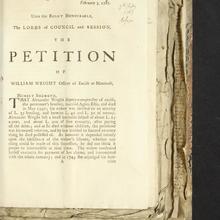
Unto the Right Honourable, The Lords of Council and Session, the Petition of William Wright Officer of Excise at Montrose
Document text (uncorrected OCR)
February 3. 1767 Unto the 3. 176 UntnoheTLO The L O R D S of C O U N C IL and S E S S IO N W ILL IAM W R IG H T Officer of Excise at Montrose U oRTLD S7OfO67 C T HAT Alexander Wright deputy-comptroller o f excisethe petitioner’s brother, married Agnes Ellis, and died in May 1747; his widow was intitled to an annuity of L. 35 Sterling, and betwixt L. 40 and L. 50 of money. Alexander Wright left a small heritable subject of about L. 15 a-year, and about L. 200 of free executry, after paying all the debts; and as he died without children, the petitioner was his nearest relation, and by law intitled to succeed to every thing he died possessed of. As however it depended intirely upon the subsistence of the widow’s liferent, whether any thing could be made of this succession, he did not think it proper to intermeddle at that time. The widow confirmed herself executrix for payment of her claims, and intromitted with the whole executry; and in 1749 she adjudged his heri table T H E P E T I T I O N O F table subjects for the same purpose, entered into possession, and died in September 1755. After her death, Mary Ellis, her niece and representative, continued the possession o f these subjects, of which a conside- rable reversion remained. As she could not be prevailed up on to do the petitioner justice by fair means, tho’ she could pretend no right whatever to this reversion, the petitioner was obliged to bring against her, and the Reverend Mr Robert G illon minister of the gospel at Leffudden, her husband, for his interest, a process of reduction, extinction, compt, reckon ing, and payment. This process came in course before Lord Milton, and there after was remitted to Lord Stricken. Notwithstanding the unwillingness of the defenders to accompt, when the cause came into court, they could not offer the shadow of a reason for keeping possession of these subjects to which they had no righ t; and, at the first calling, they were ordained to give in an accompt of charge and discharge. Several vouch ers having been produced, they were put into the hands of Mr T homas Boswall, by the Lord Ordinary’s appointment, to make up an accompt; and, upon his report, some questions arose betwixt the parries, which are all finally determined by the Lord Ordinary, excepting one, which is the subject of this petition: And therefore it is unnecessary to give your Lord- ships a detail of the particulars of this litigation, further than what concerns the point in issue. T he question to be submitted to your Lordships, is, From what period the defenders must be liable for interest upon the free balance o f executry in their hands? Alexander Wright died in May 1747, a few days before Whitsunday; and it ap- pears from Mrs Boswal’s report, that about L. 250 of th e L. 334 of gross executry, consisted of money lent out upon interest, and after deducing L. 133, the amount of the debts, there re mained in her hands about L. 200 of free executry, as a se- curity for her annuity. As about L. 250 of the gross execu try... I try consisted of money bearing interest, she had no occasion to uplift more than about L. 50, which was sufficient, together with the lying money, value of the furniture, books, &c. to pay all the debts due by the defunct, exclusive of his widow’s claim. In this situation the petitioner infilled that this L. 200 of free balance must continue to bear interest against the widow, and the defender her representative, from Mr Wright’s death: That at the terms when her annuity fell due, she behoved to take it, in the first place, out of the rent of the heritable subjects; 2dly, Out of the interest of this balance of executry, and the excrescence out of the principal; and so periodically so long as her liferent subsisted. The Lord Ordinary, inter alia, “ found the defenders liable for the annualrents of the sums confirmed from one year after the date of the confirmed teftament.” The petition er preferred a representation against different points contained in this interlocutor, and particularly praying an alteration, fo far as concerned the question of interest; and of this date the Lord Ordinary pronounced an interlocutor, determining all the other points, but taking no notice of this of the interest. T his obliged the petitioner to trouble his Lordship with ano ther representation upon this point; which having advised with answers, he did of this date refuse the desire thereof, and ad here to his former interlocutor of the 29th January 1765. The petitioner must beg leave to trouble the court with a few lines upon this subject, as about L. 10 Sterling depends upon this question, which will make a considerable figure in the balance that will be found due to him by the defenders. 1mo, The petitioner is advised, that it is now a point un- derstood in the court, that executors are liable for the an nualrents of sums lying out at interest, from the death of the defunct, or at least from the first term thereafter. In former times, executors were not thought liable for any interest T heir duty is to uplift and in-gather the whole funds of the de- funct, in order to be paid away to those having right to them. They They would not lend them out; because they behoved to be ready at a ca ll; and if they did, as the money was upon their risk, they could not be liable in interest. It was never thought, however, that an executor was intitled to make any profit by keeping the money in his hands; but the impossibility of dis- posing of it otherways, was the sure reason for the former de- cisions. Now the case is altered. Any person who has money in his hands, if he has no immediate occasion for it, can lend it out in such a way, that he can command it on one hour’s warning, and he can insure it for a trifle against all possibility o f being lost. An executor, therefore, as a factor or manager for other people, ought to lay it out in such a way as to be most profitable for all parties concerned; and cannot be in- titled to put in his pocket what belongs t o other people. It is from these equitable considerations, that your Lordships have of late been in use to find executors liable in the annual- rent of sums bearing interest, until the division comes to be made. These sums need not be uplifted till that time; and there can be no danger of losing the money, when it can be insured for a trifle. This was so decided in the very late case of Watsons against Watsons, 12 December 1765; your Lord- ships there found “ the defenders not liable for the interest of the subject confirmed by their mother, as executrix con- firmed to her husband, in so far as that subject did not bear interest at the time of his death; but found them liable for the interest of the sums bearing interest, and for the rents o f the dwelling-house and shop from the Whitsunday after the father’s decease.” Agreeable to this decision, which is directly in point, if this were a general question, from what time executors are liable in annualrent of money bearing interest? your Lordships would undoubtedly find the defend ers liable from Whitsunday 1747, the first term after Alexan der Wright’s death. But, 2d0, The present case appears to the petitioner to be o f a different nature, and a good deal stronger in his favour than the the case of Watsons. With regard to the balance in que- stion, Agnes Ellis could not be looked upon as an executrix, but as a creditor. Immediately after her husband’s death, she performed the part of executrix, by paying off all his move- able debts, amounting to about L. 133 Sterling; and the free balance of L. 200, had it not been for her claim of annuity, would have been paid to the petitioner, who had the only right to it. Instead of doing this, she thought proper to keep this money in her own hand as a security for her liferent. In that situation she could not pretend to refuse to allow the interest; because that would have been raising her annuity to L. 4 5 instead of L. 35. Accordingly, the defenders have not disputed, that they are liable to account for this interest from Whitsunday 1748, a year after Mr Wright died; and, if that is just, the petitioner confesses, he cannot see a rea- son why they should not be liable for the year after his death. Whether she allowed the money to remain where it was, or uplifted it, and lent it out again to her own mind, is all one to the present purpose. She certainly received a year’s interest upon this money preceding Whitsunday 1748; and as a year’s annuity was due her at that period, she could not, by any rule of law or of equity, pretend to take this L. 10 over and above her annuity. If she had right to this, by the same rule she was intitled to the same claim every subsequent year, which has not been pretended by the defenders, and the contrary of which has been found by the Lord Ordi nary. May it therefore please your Lordships, to alter the Lord Ordinary's interlocutor; and to f ind, that the defenders must be liable for interest upon the balance question from Mr Wright’s death, or at least from Whitsunday 1747, the subsequent term; and to remit to the Lord Ordinary to proceed accordingly. According to justice, &c. PAT. MURRAY.
