Citation
Related Case Materials
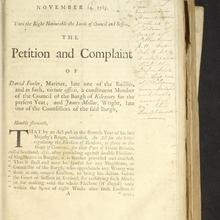
Unto the Right Honourable the Lords of Council and Session, the Petition and Complaint of David Fouler, Mariner, late one of the Baillies, and as such, virtute officii, a constitutent Member of the Council of the Burgh of Kilrenny for the present Year; and James Millar, Wright, late one of the Counsellors of the said Burgh
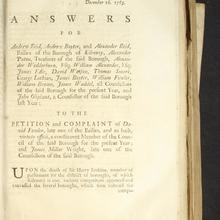
Answers for Andrew Reid, Andrew Boyter, and Alexander Reid, Bailies of the Borough of Kilrenny, Alexander Paton, Treasurer of the said Borough, Alexander Wedderburn, Esq; William Alexander, Esq; James Edie, David Watson, Thomas Smart, George Lothian, James Boyter, William Fowler, William Brown, James Waddel, all Counsellors of the said Borough for the present Year, and John Oliphant, a Counsellor of the said Borough last year; to the Petition and Complaint of David Fowler, late one of the Bailies, and as such, virtute officii, a constituent Member of the Council of the said Borough for the present Year; and James Millar Wright, late one of the Counsellors of the said Borough
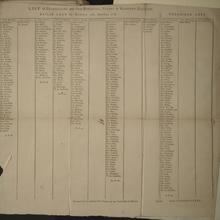
List of Counsellors and Old Burgesses, Voters at Kilrenny Election, 19 September 1765
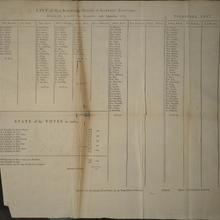
List of New Burgesses, Voters at Kilrenny Election, 19 September 1765
Respondents Proof in the Petition and Complaint, David Fowler and James Millar, against Andrew Boyter, and others, Magistrates and Counsellors of Kilrenny
Copy of the Proof Adduced for the Complainers, in the Petition and Complaint, at the Instance of David Fowler Mariner, late one of the Bailies, and, as such, virtute officii, a constituent Member of the Council of the Burgh of Kilrenny for the present Year, and James Millar Wright, late one of the Counsellors of the said Burgh, against Andrew Boyster, Andrew Reid, and others, pretended Bailies, Treasurer, and Counsellors of the said Burgh, relative to the Election of the Magistrates and Counsellors of the Burgh of Kilrenny, made at Michaelmas 1765, taken in consequence of the following Interlocutor of the Lords of Council and Session
Memorial for David Fowler and James Miller, Complainers, against Andrew Boyter and others, Respondents, Upon the Proof in the Case of the Kilrennie Election
Memorial and Abstract of the Proof for Andrew Reid, Andrew Boyter, and Alexander Reid, Bailies of the Borough of Kilrenny; Alexander Paton, Treasurer; Alexander Wedderburn, Esq; William Alexander, Esq; James Edie, David Watson, Thomas Smart, George Lothian, James Boyter, William Fouler, William Brown, and James Waddel, all Counsellors of the said Borough for the present Year, and John Oliphant a Counsellor of that Borough for last Year; against David Fouler, late one of the Bailies, and James Millar, late one of the Counsellors of the said Borough
Answers for Andrew Boyter, Andrew Reid, and Alexander Reid, Baillies of the burgh of Kilrenny; Alexander Paton, Treasurer of the said burgh; William Alexander, Esq; James Edie, Thomas Smart, James Boyter, James Waddel, Robert Anderson, Robert Alexander, Esq; David Watson, George Lothian, William Fouler, and Robert Prat, Counsellors of the said burgh of Kilrenny, elected at Michaelmas 1766; to the Petition and Complaint of David Fouler, and James Millar
Kilrenny Election. David Fowler, and James Miller Complainers, Andrew Boyter, and others, Magistrates and Counsellors of the Borough of Kilrenny, elected at Michaelmas 1765, Respondents; The Respondents Case
Answers for Andrew Boyter, and others, Magistrates and Counsellors of the Borough of Kilrenny; to The Petition of David Fowler late Bailie of Kilrenny, and James Millar late Counsellor of that Borough
Document text (uncorrected OCR)
A N S W E R S FO R Andrew Reid, Andrew Boyter, and Alexander Reid, Bailies o f the Borough o f Kilrenny, Alexander P aton, Treasurer o f the said Borough, Alexan der W edderburn, Efq; William Alexander, Efq; James Edie, D avid W atson, Thomas Smart, George Lothian, James Boyter, William Fowler, William Brown, James Waddel, all Counsellors o f the said Borough for the present Year, and John Oliphant, a Counsellor o f the said Borough last Y e a r; ' T O T H E P E T I T I O N and C O M P L A I N T of Da v id Fowler, late one o f the Bailies, and as such, virtute officii, a constituent Member of the Coun cil of the said Borough for the present Year; and James M illar Wright, late one of the Counsellors of the said Borough. U PON the death of Sir Harry Erskine, member ofparliament for the district of boroughs, of which Kilrenny is one, various competitors appeared and canvassed the several boroughs, which soon reduced the- • compe- •competition to two candidates, viz. Sir John Anstruther, a 'gentleman of fortune in that neighbourhood, and William Alexander, E sq; merchant in Edinburgh, who has since resigned his interest to his elder brother, Robert Alexander, E sq; whose character from his first appearance in life, im proved by a liberal education, and supported by the interest and connections naturally arising from his extensive and u seful trade, gave him a ju st title to hope for the uninflu enced choice of this district of boroughs. Sir John Anstruther was an entire stranger to the bo rough of Kilrenny; for though he lived in Fife, he had no more connection with the council and inhabitants of that borough than if he had lived in Orkney. He has indeed, for three months past, been very assiduous in courting the favour of the magistrates and council, not upon the footing of a natural interest in the borough, but by the most illegal • attempts to corrupt the electors. On the other hand, Mr William Alexander, who first ap peared as a candidate against Sir John, was well known to many of them, by the extensive trade of his house. Some of the council and inhabitants of this borough, were in his and his brother’s employment, in the seafaring way, long be fore the present competition. He had been their represen- tative in the convention of Royal Boroughs, and had, in that capacity, done them some material services; so there is little wonder that the council was disposed to prefer him to the other candidate, who was no otherwise known to them but by his having a large estate in the county, and by the disgust s which he had formerly given to some of the boroughs of the district which were most connected with him; from which, it was presumed, he could have lit tle hopes of their favour or interest at an election. By the set of the borough of Kilrenny, the council consi sts of three bailies, a treasurer, and eleven counsellors. The elec tion is on the 3d Thursday of September. On that day the magi- magistrates and council meet, and vote the new council for the ensuing year: After which, the new council makes a leet of three of their own number for the choice of each bailie, and three for the choice of treasurer, the old bailies and treasurer being in these leets. The whole habile bur gesses are then assembled, in consequence of a public ad- vertisement three days before, and proceed to poll for the bailies and treasurer from the leets given by the council. In the election now complained of, there were but two counsellors voted out, viz. James Millar wright, and John Oliphant exciseman; and one bailie changed by the poll, viz. the complainer, David Fowler. This general view of the election scarce presents the idea of a competi tion in this borough; and yet these two persons, Fowler and Millar, unsupported by any one other member of the corporation, presume to pray your Lordships to reduce and make void the whole election of the magistrates and council of this borough, and consequently to forfeit the corporation of its legal franchise. The votes in the poll were as Stated in the complaint; but the petitioners have omitted some material circum stances. Upon Monday the 16th of September, proclama tion was made by tuck of drum, that the poll was to be on Thursday the 19th of that month. Twenty-six of those who voted for David Fowler were made burgesses upon Wednesday the 18th, and their tickets were delivered to them by David Fowler, or some other of Sir Johns agents, on Thurs day morning, about an hour before the poll be gan. All of them were men-servants or labourers; none of them ever were, or now are, on the stent-roll, and a regular protest was taken against their votes; so that if the poll had been taken of the burgesses habilely admitted, before the public advertisement of the poll, according to the usage of the borough, there would have been a majority of 29 legal legal voters in favour of Mr Alexander Reid, against none of whom any objection or protest was taken. It is also proper to observe, That the poll having conti nued from eleven o’clock in the forenoon to four o’clock in the afternoon, and the whole voters for David Fowler ha- ving polled, there remained 31 voters, who declared their intention to poll for Bailie Alexander Reid. But David Fowler, to save further trouble, declared his acquiescence in- the election, as it then stood, in presence of the council; up- on which the poll was closed, and the election declared in fa vour of Bailie Alexander Reid, by a majority of three votes. After this conduct, it is submitted to your Lordships, if it is now competent to this gentleman, Mr Fowler, to chal lenge the poll. The respondents do not apprehend that he can seriously mean it, as he must know, that even after counting his 26 new-made burgesses, a clear majority stood upon the poll f or Bailie Alexander Reid. The petitioners, in the second place, propose to reduce the election of the magistrates and council of this borough, on an averment, that four members of council, Alex- ander Paton, Andrew Boyter, Thomas Smart, and James Edie, were bribed and corrupted to new-model the council at Michaelmas last, in such a manner as to answer Mr Alexander’s views in the election of a delegate. The respondents must be permitted to say, That they are the more surprised that David Fowler should complain of undue influence in this election, that it is notorious, and will be proved, that he was induced to join Sir john An- struther by the promise of a tidesman’s place, or some other employment in the customs, made him by Sir John An- struther, or his agent s. But supposing every averment in the petition and com plaint were true, the consequence would only be, to set aside the votes of these four persons, but not to void the whole election. I f these four persons were disqualified, there there was still a clear majority in every step of the election; and it would be still competent to that majority, to fill up the council, agreeable to the set and practice of the borough, with four members, in place of those who are supposed to have been so disqualified. But the respondents have no occasion to argue the mat ter upon a false hypothecs, and they will now proceed to state their answers to the alledged corruption of these four members. And, First, with regard to Alexander Paton treasurer; It is utterly denied, that there ever was any reward, or promise of reward, given by Mr William Alexander, or any of his friends, to the said Alexander Paton, or any of his family, for his vote or interest in the said elec tion; nor is it true that an annuity of: L. 20 yearly for life was promised to him or his son. But the conduct of Sir John Anstruther, and his agents, has not been so pure with respect to this man; for, not con tented with threatening to get him turned out of the lands which he possessed under Mr Bethune of Balfour, and one Bailie Johnston, unless he would vote for Sir John Anstru- ther’s interest, they further attempted to corrupt him by very large offers;. particularly, Alexander Pall of London, one of Sir John’s agents, offered to Alexander Baton’s wife, that her husband should have what land h e pleased on Sir John’s estate, or, if he did not chuse that, that he should have a post in the customs, and L. 50 in money, to vote for Sir John. And here the respondents beg leave to observe, that the complainers, to induce your Lordships to believe, that the respondents were determined, by corupt influence, to es- pouse Mr. Alexander’s interest, have asserted, that Mr Bethune of Balfour, who has an estate in the neighbour hood of Kilrenny, was in the interest of Sir John Anstru-- ther. This assertion the respondents have good reason to deny; because they are able to prove, that this gentleman, B only only a few days before presenting this petition, did declare, in the presence of two persons of character, that he had no objection to Mr Alexander; and that though he was dissatisfied with his tenants for not paying a regard to his recommendation of Colonel Scott, and was on that account resolved to turn them out of their farms, as he had threaten ed, he would have done the same thing, had they joined Sir John Anstruther. This being the fact, the respondents shall only add, that they know nothing of any promise made by Mr Alexander, o r his agents, for indemnifying them for any loss they were to sustain by opposing Sir John Anstruther. 2dly, As to the alledged corruption of Bailie Andrew Boyter by Mr William Alexander, it is denied that there ever was any promise made to him, to educate his son James for being a matter of a ship, or to give him the Command of a ship when qualified.—It is also denied, that Bailie Boyter, or any person for his behoof, ever got 40 guineas, or any larger or less sum, from Mr Alexander, or any body for him.—As to the letter wrote by Mr Alex ander, of the 20th September, addressed to Mr Halliday the schoolmaster, for receiving James Boyter as his scholar for navigation, and promising to acknowledge him for his trouble; Mr Alexander has no reason to be ashamed of it, or to apprehend any bad consequences from it. It is well known, that he and his brother, for several years past, have been at pains to find out and educate young men of genius, in the different arts, at a very great expence. Mr Alexander became acquainted with James the son of Bailie Andrew Boyter, a young man bred to the sea, and very well married, whom the petitioners, from this last circum- stance, would ridiculously suppose incapable of making any improvements in his art or employment. He appeared to Mr Alexander to be a young man of good parts, and that by proper education, he might be fitted for a better station station in life. From this motive, Mr Alexander proposed he should learn navigation, and without any corrupt stipu- lation, wrote the letter to the schoolmaster the day after the election, with an intention, if he should deserve it, to employ him aboard one of his ships: But there was no promise made, directly or indirectly, to maintain him and his family, or to provide for him otherways than accord ing to his merit and good behaviour; which is no more than Mr Alexander has done in many other cases, and which no law can restrain, or mean to forbid in any case. And it is not very modest in these complainers, to charge this as an instance of corruption, upon Bailie Boyter and his family, when they know that it can be proved, that a lady, most nearly connected with Sir John Anstruther, in the disguise of a serving-maid, sent for Bailie Boyter’s wife to the house of Rebecca Thomson, and told her, that i f her husband would vote for Sir John, he would support the bailie and her for life. The petitioners next complain, That Thomas Smart tailor, and James Edie carpenter, have been gained to Mr Alexander’s party by promises o f considerable sums; and that, by such means, these persons, and others of the magi- strates and council, were induced to subscribe an obligation to follow every measure necessary to secure Mr Alexander’s election; and they further alledge, that threatenings were used by Mr Alexander to some of the counsellors, when they shewed an unwillingness to enter into his measures. The respondents, for answer, utterly deny the facts charged with regard to Thomas Smart and James Edie; and they know nothing of the obligations said to have been entered into by them, and the other members of coun cil; nor do they know of any threats being used to turn out any of the counsellors, upon their shewing any unwil lingness to engage in Mr Alexander’s measures. On the other hand, they have good reason to believe, that the lady formerly described, sent for the wife of Thomas Smart, and told her, that every person dependent on the government would be turned out, and those who got their bread by o- thers, would get none, unless they were Sir John's friends; but if her husband voted for Sir John, he should be kept in constant bread from one year’s end to the other. This threatening not having the desired effect, two other persons were sent to Thomas Smart himself, with different offers, one of them to the extent of L. 50. The like undue attempts were made upon James Edie. Alexander Fall of London, one of Sir John’s agents, offered him a carpenter’s warrant on board a ship of war, o r a birth in any of the King’s yards, and a purse of money to his child, i f he would vote for Sir John. William Hodge baker in Anstruther, applied to him with the like offers; and, last of all, came the Lady already mentioned, and in- sisted with Mrs Edie for her husband's vote, and offered L. 20 more than any other person would give for it. And to show your Lordships how little scrupulous Sir John Anstruther hath been in his applications to the mem bers of this borough, the respondents think it incumbent on them, to lay before the Court a very singular transac- tion which very well deserves the consideration of every person that is concerned for the preservation of the liber ties of this country. The respondents need not observe, how anxiously the law has provided against interferings of the officers of the revenue, in the election of members of parliament: It is what is noto rious to every body, and surely should not have escaped the knowledge of a gentleman that aspires to the honour of being a member of the legislature. Nevertheless, Sir John Anstruther did, on the 14th of September last, deliver to John Oliphant gauger in Wefter-Anstruther, who was then a counsellor in the borough of Kilrenny, the following letter from a commisioner o f the excise for Scotland. ‘ The ' The bearer of this letter, Sir John Anstruther, and a particular friend of mine, is now going over to Fife, to offer himself a candidate for the boroughs of Anstruther, &c. in the room of the late Sir Henry Erskine. ‘ I am told that it is in your power to assist him; and I am glad of the opportunity of putting it in your power to do it, and to oblige me. Of this you may remain as- sured, that in proportion to the service you render him, you will confer an obligation upon, &c. Sept. 12. 1765.’ ‘ I shall be glad to receive an answer from you, by the hands of Sir John Anstruther, as immediately as possible.’ In consequence of the postscript, John Oliphant return ed the following answer to the above letter. Honoured S ir I Have the honour of receiving yours by the Honourable Sir John Anstruther; and am heartily sorrow that it’s not in my power to pay that ju st obedience to your re- quest, that you might ju stly expect from me, as one on whom my bread depends: But having for some time been so harassed and dunded by Colonel Scott and Mr Alexan-J der, both candidates, for their boroughs, that I was at last obliged to declare myself in favours of the former; which promise I cannot think of falsifying, without en dangering my reputation and character, which is all I have to carry me, and my numerous small family, through this trans itory world. Besides, I have reason to believe, on the election-day, which is on Thursday first, i ’ll be incapacitate to serve any man that w ay; and I sincerely wish I never had any concern, and then I had disobliged none; but was led into it by Sir Henry Erskine, and by whose inter- eft with the honourable board of Excise I got into bread. G from From what I have said, I humbly beg to be excused, and ever remain, with all due respect, Anstruthe, Sept. 14. 1765.’ * * * ' * a * ' * * On Tuesday, the 17th of the same month, John Oli— phant received a letter from his collector, dated Monday the 1 6th, transmitting to him an order, which the collector said he had just received from the board, requiring him (Oliphant) to attend them on Wednesday at ten o’ clock and the collector added, that he must not fail to set out immediately, as he tendered his safety. The minute of this order was signed by the writer of the letter before ' mentioned, and another commissioner. John Oliphant set out accordingly for Edinburgh, was at the board at the time appointed, never was called upon; but, when the board rose, was told he was to attend against next morning. Thursday the 19th was the annual day of the election of Kilrenny, from which he was by this means kept a- way. He attended the board all Thursday morning, was not spoke to, nor acquainted of any business which the board had with him; but when it rose, the under secreta- ry delivered him a letter for his collector, and acquainted him, at the same time, that he was to be removed from his division. He has accordingly been removed, considerably to his prejudice. All this passed, when it was not known, at least at Edin burgh, that Colonel Scott was to drop his pretensions in favour of Sir John Anstruther. The respondents will make no observations on this extraordinary transaction; but your Lordships may from thence judge, how ill-advi- fed those, who wish well to that gentleman’s interest, are, in bringing groundless and frivolous complaints against others, when he himself and his friends must have known what lengths they had gone in this and the other boroughs of o f the dist r ict, in every species o f undue influence, there by breaking through the most sacred laws of their country. The respondents do further say, and will prove, if ne- cessary, that the like undue and corrupt attempts were made by Sir John’s agents upon almost every other magi- strate and counsellor of the borough, particularly upon William Fowler, David Watson, George Lothian, and • Bailie Alexander Reid; and after finding all his threaten- ings and promises like to prove ineffectual, in this and some other of the boroughs, he seems now resolved, by this and the other complaints exhibited to your Lordships, to discover the grounds of their attachment to his competi tor, which may be of use to him against another election. When these are discovered, he will find, that a merchant of fortune and extensive trade, of public spirit and great indu- stry, has resources o f interest, and capacities to serve the elect ors of a dist r ict of boroughs, sufficient to defeat the interest o f any landed gentleman, who trusts merely to his estate, and vicinity to these boroughs. In respect whereof, &c. A L E X. W I G H T.
