Citation
Alexander Gordon, Jr., "Unto the Right Honourable the Lords of Council and Session, The Petition of Gideon Kemloe, Merchant in Stonehyve," 13 Jan 1767
, Scottish Court of Session Digital Archive Project. Charlottesville: University of Virginia Law Library, 2015-2019.
Related Case Materials
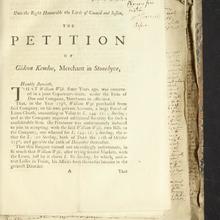
Unto the Right Honourable the Lords of Council and Session, The Petition of Gideon Kemloe, Merchant in Stonehyve
Document text (uncorrected OCR)
’January 13. 1767. Unto the Right Honourable the Lords of Council and Sesion T H E; P E T I T I O N O F Gideon Kemloe, Merchant in Stonehyve, Humbly Shew eth, TH A T William Wise, s ome Years ago. was concern ed in a joint Copartnery-trade, under the Firm of Dun and Company, Merchants in Aberdeen. That, in the Year 1756, William Wise purchased from said Company, on his own private Account, a large Parcel of Linen Cloath, amounting in Value to L. 244: 12: 9 Sterling; and as the Company required additional Security for such a considerable Sum, the Petitioner was unfortunately induced to join in accepting, with the said William Wis e, two Bills to the Company, one whereof for L. 144: 12: 9 Sterling, the o- ther for L. 133 Sterling, both of Date the 1th of October1756 and payable the 20th of December thereafter. That this Bargain turned out exceedingly unfortunate, in so much that William Wis e, after trying several Markets, with the Linen, lost by it above L 80 Sterling, by which; and o- ther Losses in Trade, his Affairs soon thereafter became in the greatest Disorder. •. ~ *' A That That this Bargain was still worse for the Petitioner- as he received no Value for joining in these Acceptances with Wil- liam Wise, but interposed his credit merely with a View to serve him, and has(been left in the Lurch to work out his, 7. u • j J W JT1 fDeliverance as he best could. That the Petitioner being charged with Horning for Pay- m e nt of the first Bill above mentioned of L. 144: 1 2: 9 Ster ling, he obtained Suspension of the same; which came in Course to be discussed before the Lord Auchinlech Ordinary, That the Grounds of Suspension of this Charge were in Substance, that the Bill upon which the Charge was found ed was overpaid; and in order to ascertain the same, the Pe titioner produced an Account current between William Wis e and the Chargers; which being advised, with Objections, Answers, and Replies, the Lord Ordinary, of this Date, "found the Letters orderly proceeded for the Sum of L..76 1T HE o 1/2 d. Sterling, with the Interest of L. 80: 17: 10 of that Sum from and since the 27th December 1764, until Payment: And finds the Suspender also liable for the Ex- pence of the Extract, conform to the Collector's Certificate; and decerns.” That a Variety of Procedure has been had in this Cause be-0 fore the Lord Ordinary, which the Petitioner apprehends it is unnecessary for the Purpose of the present Application to state. Several Representations were preferred to the Lord Ordinary, craving an Alteration of the Interlocutor above stated; and particularly in the latter End of Summer-session 17 66, the Petitioner did set forth, that in respect he, who was only Cautioner in the above Bill for William Wis e, had obtained Decreet for his Relief against Wise, and used Arrest- ments in the Hands of Mess. Dun, Reid, and Company, the Chargers, who by their Depositions formerly emitted in Pro- cess, stand confessedly indebted to the said Wis e in consider- able Sums: And therefore praying the Lord Ordinary would supercede Extract of the above Decreet until a Process o f 1 • ForthcomingH Forthcoming upon said Arrestments should be brought into Court; which Request appearing reasonable, extract was ac cordingly superceded until the 15 th of November then fol- lowing. That the Petitioner being afraid that the Chargers would take the first Opportunity of extracting their Decreet, did, early in this Sesio n, make Application to the Lord Ordinary, p ra y in g that Extract of the Decreet might be superceded un til such time as the Petitioner might have an Opportunity of being heard in his Process of Forthcoming then brought into Court. That the Lord Ordinary having ordained Answers to be given in to the above Application, was pleased, of this Date, to pronounce the following Interlocutor: “ The Lord Ordina ry having again considered this Representation, with the Answers, finds, as it is not denied that the Suspender is intitled to Relief from Wise, and admitted Dun, one of the Pursuers, is Debtor to Wise for L. 27: 4: 3; and Reid, another of the Pursuers, Debtor to him in L. 9: 19: 1 1, each of which Sums are below the third Part of the L. 82 19 s. o 1/2d., the Sum due to all the three Pursuers; allows the Decreet to go out for L. 45: 1 4: 1 0, with the Expences formerly decerned for; but stops Extract for the Remain der for a Fortnight, that the Forthcoming may come.” Against the above Interlocutor, Dun and Company, who, in the Sequel, shall be called the Chargers, complained, by a Representation to the Lord Ordinary, setting forth various affected and groundless Reasons, to be hereafter noticed, why the Lord Ordinary should recal the above-recited Interlocu tor, and allow Decreet to go out for the whole. Of this Date, the Lord Ordinary “ ordained the Chargers Representation to be answered, and specially the Averment, t hat Wis e's Creditors have arrested the Funds in the Hands of Reid and Dun, and the Answers to be put in betwixt and that Day fee’night.” Answers were accordingly made, containing containing a Counter-representation, upon the Part of the Pe titioner, craving that the Extract of the Decreet should be Simpliciter superceded. until the final Issue of the Process of forthcoming pending between same Parties. Upon advising of which, the Lord Ordinary pronounced the following In terlocutor: “Having again considered this r epresentation, with the Answers thereto, and Counter-representation for the Suspender, and more particularly that the Chargers Demand against the Suspender, is a Debt due to the Char gers in Company; and the Debts upon which the Sus penders plead Compensation, are Debts due by two of the Copartners privato nomine, and not due to the Suspender himself, but to Wis e, who, the Suspender says, is his Debt o r; allows the Decreet to go out for the whole, and refu ses the Desire of the Suspender’s Representation.” T he Petitioner, apprehending himself aggrieved by the last-recited Interlocutor, did again represent to the Lord Or dinary, and offered such Reasons as occurred to him, tending to show why Extract should be simpliciter superceded, until the final Issue of the Process of Forthcoming, which, at the Period of this Application, stood remitted by the Lord Barjarg Ordinary to his Lordship: And more particularly, that from the Words of the Interlocutor itself, it would seem that the ratio decidendi was in respect that the Debts arrested by the Peti tioner were only Debts due by two of the Copartners privato nomine but that in fact not only Arrestments were used in the Hands of James Dun and Peter Reid, as two of the Mem- bers of the Company, as Individuals, but also that there were Arrestments used in the Hands of the whole qua Compa ny) and that the Company, as well as Dun and Reid, two of the Partners, are called in the Forthcoming, so that the Petitioner apprehends he was most substantially intitled to crave, that Extract as to the whole should be superceded, as in the Event of’ the Forthcoming it is confidently believed, that the Company will be found due a greater Sum to the Petitioner, fTC U*TPetitioner, as coming in place of Wise, than the Sum of the Charge as presently decerned against him; and farther, that the Sums acknowledged to be due by Dun and R eid for their own private Accounts, were inconsiderable, compared with what he apprehended would be found due by the company in the Course of the Forthcoming: And such being the Case, more especially as the Process of Forthcoming was remitted to his Lordship, praying that Decreet ought simpliciter to be su- perceded until the final Issue of the Forthcoming. Of this Date, the Lord Ordinary was pleased to give the following Deliverance upon the above Representation: “ Ha ving considered this Representation, and former Proceed ings, and particularly the Reason mentioned in the for mer Interlocutor, together with what the Chargers plead ed in answer to the former Representation, that the Debt on which the Representers plead Compensation, is not con- stitute against the Chargers, refuses the Desire of the Re presentation, and adheres to the former Interlocutor.” Of the above Interlocutors, in so far as the Lord Ordinary has refused to supercede Extract, until the final Issue of the Forthcoming, the Petitioner humbly begs Leave to bring the same under your Lordships Review; and he is hopeful that your Lordships will have no Difficulty in being of Opinion, that, in the present Case, he is intittled to insist for staying the Execution of the Decreet in the Suspension, until the final Issue of the Process. of Forthcoming, which is founded upon, and is pars ejusdem contractus depending between the same Parties. The Arguments used upon the Part of the Chargers, in support of the Interlocutor complained of, are in substance as follows, 1 mo, They set forth, that the Chargers have Reason to lose no Time in recovering their Money from the Petitioner, being (pleased to say) they are apprehensive of their Payment, unless it is speedily recovered. But to this it is answered. that the Danger here supposed, is altogether ^ B affected affected, and without Foundation, as it is known the Peti tioner himself is not only in good Circumstances, but has found undoubted Caution in the Suspension by Patrick Cush- nie, Merchant in Stonhaven, who is likewise attested by John Duncan, Writer there, whose Credit and Circumstances are beyond all Exception. And this the Chargers will not ven ture to deny. It is likewise urged, in behalf of the Chargers, that De creet should be allowed to go out for the whole, adding, that no Inconveniency can thereby arise to the Petitioner because if he comes to be furnished with good Grounds of Compensation, he will have an Opportunity of proponing these, when Payment is demanded. And further, that al though Dun and Reid be indebted to Wise, he W ise, may reduce the Decreet against him for Relief, or his other Credi tors may be preferable by their Diligence upon the Sums ar- rested, which, it is alledged, would create great Inconve- niencies. To this it is answered, upon the Part of the Petitioner, that for the Sake of Regularity, the Extract of the Decreet should be altogether superceded, till the Fate of the Process of Forthcoming is known; because if, by the Issue of it, the Chargers shall be found to be Debtors to Wise in a Sum a- bove, or equal to the Sum decerned for to the Company, it would be unjust and oppressive, that the Petitioner should, in the mean time, be obliged to pay them by the Force of their Diligence, upon the Decreet’s being extracted. And it is believed, when the Process of Forthcoming is at an End the Petitioner, now in the right of Wise to the Extent of his Relief will be found Creditor to them in a Balance more than sufficient to repay him of his Advances made upon Wise's Account. And, in the Event, that your Lordships a f firm the Lord Ordinary s Interlocutors complained of, the Sum so awarded may not be so easi ly drawn back, the Char gers not having found Caution to pay as the Petitioner has done done. With Submission, the fair and equal Method therefore of Proceeding is that the Decreet should be altogether super- ceded for such Time as your Lordships may think sufficient and reasonable for the Petitioner to bring his Process of Forth coming to a final Issue: And if the Chargers, either as a Company, or as particular Members of the Company, are de facto Debtors to Wise, it does not occur why the one should not meet, and operate in so far as to stay the Execu tion of the Decreet. And indeed the contrary Proceeding can be calculated for no other Purpose, than to distress the Petitioner, by forcing him to pay the Debt claimed by him; though at the same time, they cannot seriously deny, but that, by the Issue of the Process of Forthcoming, they have Reason to believe they will be found to be Debtors to Wife in a considerable, if not a larger Sum. But further, the Chargers can qualify no sort of Damage by the Delay demanded, as their Money, i f it shall be found due to them, is absolutely secure, and bears Interest to them in the mean time. It is therefore ri diculous to pretend, that the Petitioner will have an Oppor tunity to propone his Grounds of Compensation, when Pay ment is demanded in virtue of their Decreet. A Charge o f Horning, or a Caption, are Diligences not so easi ly parried, and especially when in the Hands of Creditors so rigorous as the present Chargers have shown themselves to be. The Pe titioner will hereby be pardoned, in adding, that, in so far as he has been acquainted with the Conduct of the Chargers through their Management of the present Question, he has no Reason to expose himself to their Will or Pleasure, as it has required all the Diligence and Attention in his Power to re- strict their Charge, being L. 144: 12: 9, to the Sum present- ly decerned; which, by the most rigid Calculation, addi ng Interest upon Interest, amounts only to L. 82 19 s Sterling. Neither is there any Probability, i f a second Suspension should be offered, that it would take place, as the Decreet is * 9 A,r. * far for from being in absence. And such being the Case, where then is the Opportunity that the Petitioner would have, o f proponing his Grounds of Compensation? And it will be admitted, and it is equally natural to suppose, that the Pe titioner will, by the Issue of the Forthcoming, be furnished with good Grounds of Compensation, as the contrary. It is a Supposition singularly strange, that Wise hould re duce the Decreet at the Petitioner’s Instance against him for Relief. Should this be held to be a suppositio supponenda, no Decreet ol Forthco ning could ever be obtained, where the Ground of Debt is a Decreet against the common Debtor. It is uncontrovertable, that so long as a Decreet stands, it is jus tertu to the Charger to quarrel it; and whatever is found due in consequence of the Forthcoming proceeding upon that Decreet, the Chargers are in absolute Safety to pay, or allow, in whole or in part of the Sums contained in their Decreet; which evidently amounts to neither more or less, than paying Wis e's Debt-with his ow n Money. The Chargers have further said, that the Debts owing by Dun and Reid are as individual Members of the Company, but not by the Company itself; and therefore contend, are not Grounds of Compensation against: a Debt due to the Company. This Circumstance is the more worthy of your Lordships Attention, as it seems to have been the ruling Principle, upon which the Lord Ordinary’s Interlocutor complained of are founded. And therefore, 1mo. It will be observed, that the Fact stands diametrically otherwise, and is as f o l l o w s viz. That not only Dun and Reid are, as In dividuals, indebted to Wise, and Arrestments used in their Hands by the Petitioner, as coming in his place; but also that the whole Members of the Copartnery are also indebt ed to him in considerable Sums, arising from their Com- pany concerns, and arrested also by the Petitioner; which A rrestments are properly the Subject o f the Process Forth coming already brought into Court by the Petitioner: And as as the Debt now charged for arises from said Company-con cerns, and is pars ejusdmcontractus, it is, with great Sub- mission, contended, such being the Case, affords the most substantial Reason, why the Decreet should be simpliciter superceded, until the Issue of the Forthcoming, being the na- tu ra l an d effectual Method of having the same ascertain- ed. 2do, As it appears by the Depositions of two of the Part ners of said Company, that they are indebted to Wise, one of them in L. 27: 4: 3 Sterling, the other for L 9: 9: 1 1 Sterling, it seems highly reasonable, that the Petitioner should have Deduction of the same, at least in so far as these private Partners are intitled to draw, as their Share of the L. 82, the Company-debt now decerned for. And in deed it seems highly equitable, and as fuch it is submitted to your Lordships, that as every Member has a particular Interest in the Debts of the Company, so the Debt due by each Member ought, in Juftice and Equity, pro tanto to af- fect his own Proportion, because to that Extent he becomes both Debtor and Creditor. It will be observed, from the Proceedings already stated, that the Plea maintained by the Petitioner does not directly amount to that of Compensation, but only to a Claim of Retention, or Stay of Judgment, for such reasonable Time as your Lordships may think proper to allow him to carry on the Process of Forthcoming; by which means alone he inclines to liquidate the Debts due by the Company to Wise. In the present Case, the Petitioner is advised, that many Circumstances concur, such as ought to intitle him to the above Request: For your Lordships will observe, that the Sum now decerned for against the Petitioner, is expressly a Company-debt; and as the Claims proposed to be made ef fectual by the Forthcoming, are also Company-debts, and partes ejus dem negoti,it seems highly ju st and equitable, that your Lordships should grant such Delay of the Execution of C. the the Decreet in the Suspension as will give the Petitioner an Opportunity of being heard in the Forthcoming pending, be tween the same Parties, relative to partes ejusdem negotii, and now remitted to the same Ordinary. Neither does such an Indulgence as now required seem unknown and unprecedented in this Court. Many Instances might be given where Debts not liquid were allowed to ope- rate bycomnsati beig lquidate posri thir be-ing ofred ibar ofthePursit. Theptionr wilbeg Lav to state to your Lordships a Question much of a simi- lar Nature with the present, reported by Fountainhal, 14th January 1686, between ‘James Brown and John Elites. “ Mr J o h n b e i n g c h a r g e d o n a clear liquid Pond granted by him to u m q u h i l e William Brown, and asign ed by him unto his Son James, he craved Compensation because WilamBrownthe Cedent was Debtor to him, in so far as E lieston intrusted his Name in an A ssignation of a Debt owing him by Gor- don o f Buckie and Macintosh of Borlum; and which Trust did appear from his own Count-books, and an Oath he had given in another Process: And it was offered to be proven, that, by virtue of this Trust, he had uplifted and ntromedwhSusfMyqvalcg.A,TCpb14P592dl;RBVijctLqj as cingendus pro cincto, et dies inchoatus pro completo in favorabilus; and that Menochius, lib. 2 centur. 1 casu 14, debating how long Time ought to be granted for liquida-ting a debt whereon Compensation is craved, tells, that Bartolus # Bartolus ad lib. 46. § 4 D de ju re fisci, allows two Months; but he places it in arbitrio ju d ic is; and the Lords, on the 22 d of November 1683, Seton, allowed three Months: And though the Pursuer be an Assignee, yet the Compensation must meet him, whether the Assignation to his Son be gratuitous or onerous, for Relief of Cautionries; it being undoubted Law, that exceptio obstat cedenti obstabet et cessionario; the Reason whereof is, quia exceptio compensationis non cohaeret personae sed rei; and so extinguishes the Debt pro tanto et trans it etiam in s ingulares s uccessores The Lords, on this Debate being reported, would not tie to prove instantly his Grounds of Compensation, though it was his Reason of Suspension, but being in facto, allow ed him to the 1st of February to liquidate the same. And on a Bill, they prorogated it to the 20th of March: And upon a W itness’s not compearing, was afterwards delayed until the 1 oth of January thereafter." The Case mentioned in the above Decision, the Petitioner humbly apprehends to be much in point; as also the Case of Seton. mentioned therein, to which Reference is had. But as these are not the single Authorities upon which the Peti tioner rests his Plea, he would beg Leave to lay before your Lordships a recent Decision in point, in the Case Burroughs contra Sir Archibald Grant, 28th July 1 732; in which Case your Lordships, inter alia, “ found it competent to the De fender to plead Retention to the Extent of the An- nualrents of the Bond during Mr Burroughs L ife: Found the Pursuer Mrs Burroughs, who administra- ted the Effects of the deceased Mr Burroughs her Husband in England, is not bound to account: But to the End Sir Archibald Grant may have a competent Time to constitute the Debts owing him by Mr Burroughs, and bring the Pursuer to account for her deceased Husband’s Effects in a proper Court 111 England, stopped Procedure in this Action, C 2 “both w '
